Calculating attributable numbers and rates in `cityClimateHealth`
attributable_number.RmdEstimating Attributable numbers (and rates of attributable numbers) are a key way that we can translate relative risks into numbers that are more tangible in public health settings. Below we provide easy functionality to go from our model objects to estimates of attributable numbers and rates.
Setup
The first step of calculating attributable numbers is having a population data estimate.
This varies a lot by place and dataset, so we don’t include
functionality for it (but an example of how this could be done can be
seen in vignette("get_pop_estimates")).
Reminder - the data used in this example are simulated.
Assume you are starting with a dataset for the entire timeframe that looks like this:
library(data.table)
data("ma_pop_data")
setDT(ma_pop_data)
ma_pop_data
#>               TOWN20 Female_0-17 Female_18-64 Female_65+ Male_0-17 Male_18-64
#>               <char>       <num>        <num>      <num>     <num>      <num>
#>   1:      BARNSTABLE        3899        15017       6014      4499      14035
#>   2:          BOURNE        1891         5751       3212      1489       5302
#>   3:        BREWSTER         634         2518       2007       833       2628
#>   4:         CHATHAM         163         1477       1759       480       1265
#>   5:          DENNIS         573         3792       3133       784       4101
#>  ---
#> 347:   WEST BOYLSTON         619         2021       1107       604       2554
#> 348: WEST BROOKFIELD         343         1162        578       243       1002
#> 349:     WESTMINSTER         847         2371       1131       762       2028
#> 350:      WINCHENDON        1254         3318        711      1031       3134
#> 351:       WORCESTER       18779        67750      15995     21129      69365
#>      Male_65+
#>         <num>
#>   1:     5458
#>   2:     2810
#>   3:     1721
#>   4:     1463
#>   5:     2359
#>  ---
#> 347:      790
#> 348:      495
#> 349:     1081
#> 350:      924
#> 351:    11173
Need to do some transformations:
- pivot longer
- variable clean
Note again, this processing will vary by application so this approach is not prescriptive !
Pivot longer:
ma_pop_data_long <- melt(
  ma_pop_data,
  id.vars = "TOWN20",
  variable.name = "sex_age",
  value.name = "population"
)
Variable clean:
ma_pop_data_long$sex_age <- as.character(ma_pop_data_long$sex_age)
varnames <- strsplit(ma_pop_data_long$sex_age, "_", fixed = T)
varnames <- data.frame(do.call(rbind, varnames))
names(varnames) <- c('sex', 'age_grp')
rr <- which(varnames$sex == 'Female')
varnames$sex[rr] <- 'F'
rr <- which(varnames$sex == 'Male')
varnames$sex[rr] <- 'M'
ma_pop_data_long$sex = varnames$sex
ma_pop_data_long$age_grp = varnames$age_grp
ma_pop_data_long$sex_age <- NULL
ma_pop_data_long
#>                TOWN20 population    sex age_grp
#>                <char>      <num> <char>  <char>
#>    1:      BARNSTABLE       3899      F    0-17
#>    2:          BOURNE       1891      F    0-17
#>    3:        BREWSTER        634      F    0-17
#>    4:         CHATHAM        163      F    0-17
#>    5:          DENNIS        573      F    0-17
#>   ---
#> 2102:   WEST BOYLSTON        790      M     65+
#> 2103: WEST BROOKFIELD        495      M     65+
#> 2104:     WESTMINSTER       1081      M     65+
#> 2105:      WINCHENDON        924      M     65+
#> 2106:       WORCESTER      11173      M     65+
We assume that these properties hold for the entire timeframe of our analysis, but you could also make a version of this dataset with a ‘year’ column.
Now, quickly get a condPois_1stage() and
condPois_2stage() objects to use in testing: exposures
library(data.table)
exposure_columns <- list(
  "date" = "date",
  "exposure" = "tmax_C",
  "geo_unit" = "TOWN20",
  "geo_unit_grp" = "COUNTY20"
)

ma_exposure_matrix <- make_exposure_matrix(
  subset(ma_exposure, COUNTY20 %in% c('MIDDLESEX', 'WORCESTER')),
  exposure_columns,
  time_subset = list(month = 5:9,
                     year = 2013:2015))
#> -- NA values automatically removed
#> strata dt_by = 'day', setting strata as geo_unit:yr:mn:dow
outcomes
outcome_columns <- list(
  "date" = "date",
  "outcome" = "daily_deaths",
  "geo_unit" = "TOWN20",
  "geo_unit_grp" = "COUNTY20"
)

ma_outcomes_tbl <- make_outcome_table(
  subset(ma_deaths,COUNTY20 %in% c('MIDDLESEX', 'WORCESTER')),
  outcome_columns,
  time_subset = list(month = 5:9,
                   year = 2012:2015))
#> Missing outcome values introduced by xgrid were set to 0;
#>             assumes that every time in the dataset should have an outcome value
#> strata dt_by = 'day', setting strata as geo_unit:yr:mn:dow
models
ma_model <- condPois_2stage(ma_exposure_matrix, ma_outcomes_tbl, verbose = 1, global_cen = 20)
#> -- validation passed
#> -- stage 1
#>
#> crossbasis args for geo_unit  ACTON :
#>
#> maxlag: 5
#>
#> argvar:
#> List of 2
#>  $ fun  : chr "ns"
#>  $ knots: Named num [1:2] 25.6 31.3
#>   ..- attr(*, "names")= chr [1:2] "50%" "90%"
#>
#> arglag:
#> List of 2
#>  $ fun  : chr "ns"
#>  $ knots: num [1:2] 0.878 2.095
#>
#> strata:
#> ACTON:yr2013:mn05:dow04
#> strata_min: 0
#>
#> min_n: 50
#>
#> truncate final RR and basis cen:  0
#> formula:
#>    daily_deaths ~ cb
#> family: quasipoisson
#>
#> -- mixmeta
#> formula: coef_matrix ~ exp_mean + exp_IQR
#> random: ~ 1 | COUNTY20/TOWN20
#> -- stage 2
#> truncate final RR and basis cen:  0.01
Estimating the AN
Ok so now you pass in population.
So now estimate the AN as a full object
Remember that this needs to be compatible for:
single zone
ma model with ma_model$
_ma model with factor ma_model$
0-17> I think you can handle this the same way you did before, with recursion
Now in this second step, you can choose the aggregation level that you want results to.
In this block you need:
what spatial resolution are you summarizing to: ->> ‘geo_unit’, ‘geo_unit_grp’, or ‘all’
are you just getting the impacts that are > then the centering point: ->> lets just assume yes for now, can always go back and change it
ma_AN <- calc_AN(ma_model, ma_outcomes_tbl, ma_pop_data_long,
                 spatial_agg_type = 'TOWN20',
                 spatial_join_col = 'TOWN20',
                 nsim = 100,
                 verbose = 2)
#> -- validation passed
#> -- estimate in each geo_unit
#> 5    10  15  20  25  30  35  40  45  50  55  60  65  70  75  80  85  90  95  100     105     110
#> -- summarize by simulation
#> 5    10  15  20  25  30  35  40  45  50  55  60  65  70  75  80  85  90  95  100
#> -- applying scale of :  1
ma_AN$`_`$rate_table
#>          TOWN20  COUNTY20 population above_MMT mean_annual_attr_rate_est
#>          <char>    <char>      <num>    <lgcl>                     <num>
#>   1:      ACTON MIDDLESEX      23864      TRUE                 2509.5332
#>   2:      ACTON MIDDLESEX      23864     FALSE                 -141.4264
#>   3:  ARLINGTON MIDDLESEX      45906      TRUE                 2607.2300
#>   4:  ARLINGTON MIDDLESEX      45906     FALSE                 -153.3024
#>   5: ASHBURNHAM WORCESTER       6337      TRUE                 1708.2216
#>  ---
#> 224: WINCHESTER MIDDLESEX      22809     FALSE                 -203.3189
#> 225:     WOBURN MIDDLESEX      40992      TRUE                 2516.0397
#> 226:     WOBURN MIDDLESEX      40992     FALSE                 -103.6788
#> 227:  WORCESTER WORCESTER     204191      TRUE                 2279.6059
#> 228:  WORCESTER WORCESTER     204191     FALSE                 -176.9789
#>      mean_annual_attr_rate_lb mean_annual_attr_rate_ub
#>                         <num>                    <num>
#>   1:                1886.6546               3097.99803
#>   2:                -219.2109                -73.77745
#>   3:                2161.9995               3049.42437
#>   4:                -217.0604                -97.86302
#>   5:                1232.5430               2128.66893
#>  ---
#> 224:                -266.9177               -139.14464
#> 225:                1939.5400               3026.88634
#> 226:                -152.2096                -51.24476
#> 227:                1946.8292               2687.72252
#> 228:                -258.4957               -117.72679
ma_AN$`_`$number_table
#>          TOWN20  COUNTY20 population above_MMT mean_annual_attr_num_est
#>          <char>    <char>      <num>    <lgcl>                    <num>
#>   1:      ACTON MIDDLESEX      23864      TRUE                  598.875
#>   2:      ACTON MIDDLESEX      23864     FALSE                  -33.750
#>   3:  ARLINGTON MIDDLESEX      45906      TRUE                 1196.875
#>   4:  ARLINGTON MIDDLESEX      45906     FALSE                  -70.375
#>   5: ASHBURNHAM WORCESTER       6337      TRUE                  108.250
#>  ---
#> 224: WINCHESTER MIDDLESEX      22809     FALSE                  -46.375
#> 225:     WOBURN MIDDLESEX      40992      TRUE                 1031.375
#> 226:     WOBURN MIDDLESEX      40992     FALSE                  -42.500
#> 227:  WORCESTER WORCESTER     204191      TRUE                 4654.750
#> 228:  WORCESTER WORCESTER     204191     FALSE                 -361.375
#>      mean_annual_attr_num_lb mean_annual_attr_num_ub
#>                        <num>                   <num>
#>   1:               450.23125               739.30625
#>   2:               -52.31250               -17.60625
#>   3:               992.48750              1399.86875
#>   4:               -99.64375               -44.92500
#>   5:                78.10625               134.89375
#>  ---
#> 224:               -60.88125               -31.73750
#> 225:               795.05625              1240.78125
#> 226:               -62.39375               -21.00625
#> 227:              3975.25000              5488.08750
#> 228:              -527.82500              -240.38750
you can change spatial_agg_type to be a different
spatial resolution – either whatever the group variable was or “all”
ma_AN <- calc_AN(ma_model, ma_outcomes_tbl, ma_pop_data_long,
                 spatial_agg_type = 'COUNTY20',
                 spatial_join_col = 'TOWN20',
                 nsim = 100,
                 verbose = 2)
#> -- validation passed
#> -- estimate in each geo_unit
#> 5    10  15  20  25  30  35  40  45  50  55  60  65  70  75  80  85  90  95  100     105     110
#> -- summarize by simulation
#> 5    10  15  20  25  30  35  40  45  50  55  60  65  70  75  80  85  90  95  100
#> -- applying scale of :  1
ma_AN$`_`$rate_table
#>     COUNTY20 population above_MMT mean_annual_attr_rate_est
#>       <char>      <num>    <lgcl>                     <num>
#> 1: MIDDLESEX    1623109      TRUE                 2540.9569
#> 2: MIDDLESEX    1623109     FALSE                 -132.0614
#> 3: WORCESTER     858898      TRUE                 2228.0585
#> 4: WORCESTER     858898     FALSE                 -145.4917
#>    mean_annual_attr_rate_lb mean_annual_attr_rate_ub
#>                       <num>                    <num>
#> 1:                2472.0367                2614.0181
#> 2:                -141.4096                -124.1968
#> 3:                2108.4656                2323.8782
#> 4:                -164.6419                -129.6938
ma_AN$`_`$number_table
#>     COUNTY20 population above_MMT mean_annual_attr_num_est
#>       <char>      <num>    <lgcl>                    <num>
#> 1: MIDDLESEX    1623109      TRUE                41242.500
#> 2: MIDDLESEX    1623109     FALSE                -2143.500
#> 3: WORCESTER     858898      TRUE                19136.750
#> 4: WORCESTER     858898     FALSE                -1249.625
#>    mean_annual_attr_num_lb mean_annual_attr_num_ub
#>                      <num>                   <num>
#> 1:               40123.850               42428.363
#> 2:               -2295.231               -2015.850
#> 3:               18109.569               19959.744
#> 4:               -1414.106               -1113.938
See that the numbers are roughly the same for Suffolk county ? They won’t be exactly the same because of how the averaging works.
Some plot functions exist:
plot(ma_AN, table_type = 'rate', above_MMT = T)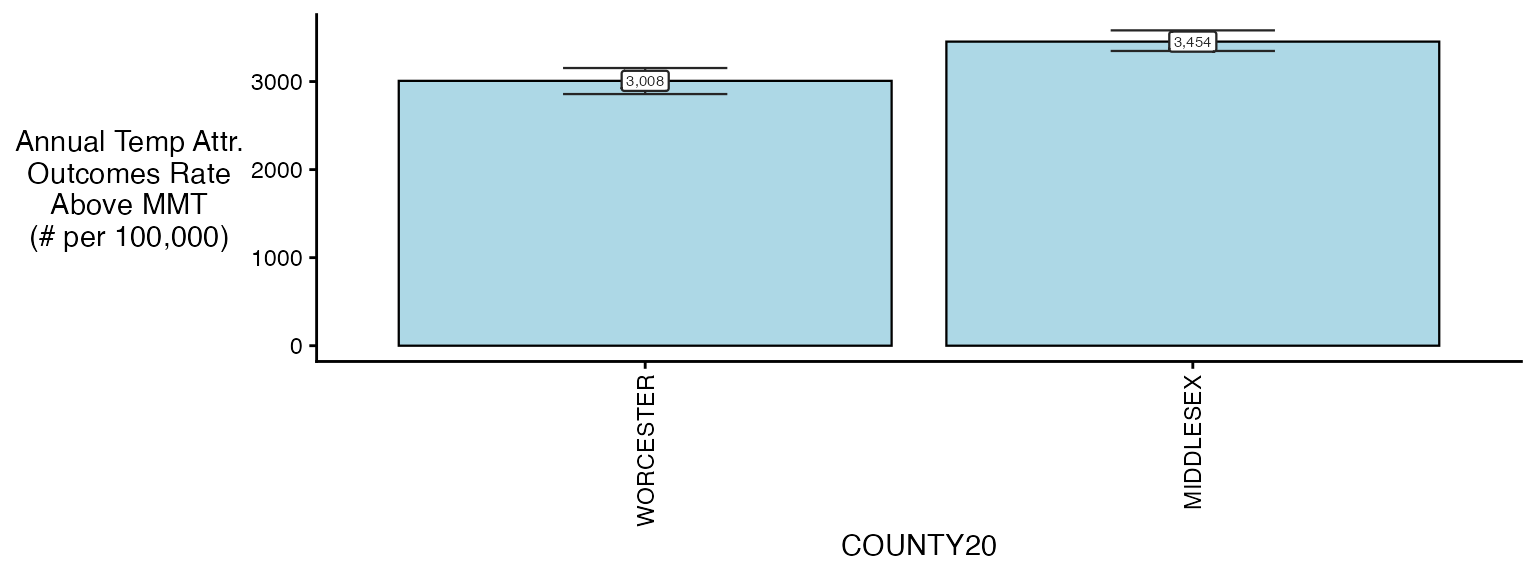
plot(ma_AN, table_type = 'rate', above_MMT = F)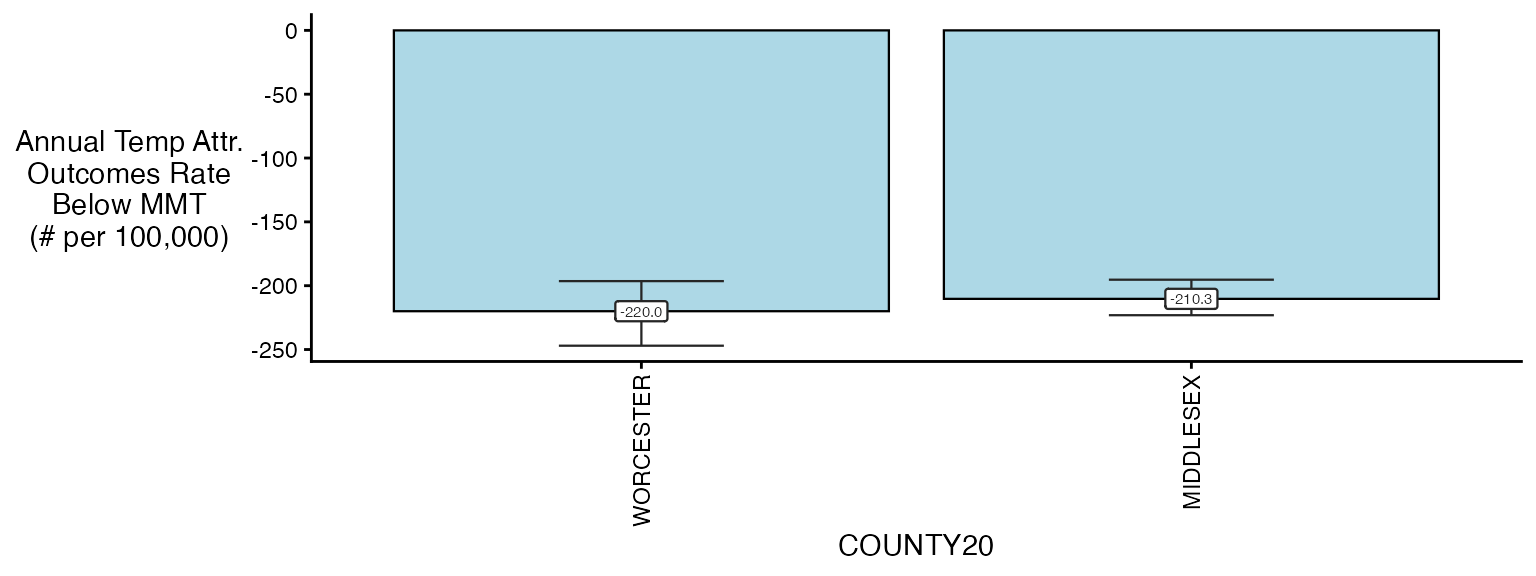
Estimating the AN - single
check of single
# run the model
m2 <- condPois_1stage(exposure_matrix = ma_exposure_matrix,
                  outcomes_tbl = ma_outcomes_tbl,
                  multi_zone = TRUE, global_cen = 15)
#>
#> crossbasis args for geo_unit  ACTON,ARLINGTON,ASHBURNHAM,ASHBY,ASHLAND,ATHOL,AUBURN,AYER,BARRE,BEDFORD,BELMONT,BERLIN,BILLERICA,BLACKSTONE,BOLTON,BOXBOROUGH,BOYLSTON,BROOKFIELD,BURLINGTON,CAMBRIDGE,CARLISLE,CHARLTON,CHELMSFORD,CLINTON,CONCORD,DOUGLAS,DRACUT,DUDLEY,DUNSTABLE,EAST BROOKFIELD,EVERETT,FITCHBURG,FRAMINGHAM,GARDNER,GRAFTON,GROTON,HARDWICK,HARVARD,HOLDEN,HOLLISTON,HOPEDALE,HOPKINTON,HUBBARDSTON,HUDSON,LANCASTER,LEICESTER,LEOMINSTER,LEXINGTON,LINCOLN,LITTLETON,LOWELL,LUNENBURG,MALDEN,MARLBOROUGH,MAYNARD,MEDFORD,MELROSE,MENDON,MILFORD,MILLBURY,MILLVILLE,NATICK,NEW BRAINTREE,NEWTON,NORTH BROOKFIELD,NORTH READING,NORTHBOROUGH,NORTHBRIDGE,OAKHAM,OXFORD,PAXTON,PEPPERELL,PETERSHAM,PHILLIPSTON,PRINCETON,READING,ROYALSTON,RUTLAND,SHERBORN,SHIRLEY,SHREWSBURY,SOMERVILLE,SOUTHBOROUGH,SOUTHBRIDGE,SPENCER,STERLING,STONEHAM,STOW,STURBRIDGE,SUDBURY,SUTTON,TEMPLETON,TEWKSBURY,TOWNSEND,TYNGSBOROUGH,UPTON,UXBRIDGE,WAKEFIELD,WALTHAM,WARREN,WATERTOWN,WAYLAND,WEBSTER,WEST BOYLSTON,WEST BROOKFIELD,WESTBOROUGH,WESTFORD,WESTMINSTER,WESTON,WILMINGTON,WINCHENDON,WINCHESTER,WOBURN,WORCESTER :
#>
#> maxlag: 5
#>
#> argvar:
#> List of 2
#>  $ fun  : chr "ns"
#>  $ knots: Named num [1:2] 25.3 30.3
#>   ..- attr(*, "names")= chr [1:2] "50%" "90%"
#>
#> arglag:
#> List of 2
#>  $ fun  : chr "ns"
#>  $ knots: num [1:2] 0.878 2.095
#>
#> strata:
#> ACTON:yr2013:mn05:dow04
#> strata_min: 0
#>
#> min_n: 50
#>
#> truncate final RR and basis cen:  0.025
#> formula:
#>    daily_deaths ~ cb
#> family: quasipoisson

ma_AN_s1 <- calc_AN(m2, ma_outcomes_tbl, ma_pop_data_long,
                 spatial_agg_type = 'COUNTY20',
                 spatial_join_col = 'TOWN20',
                 nsim = 100,
                 verbose = 2)
#> -- validation passed
#> -- estimate in each geo_unit
#> 5    10  15  20  25  30  35  40  45  50  55  60  65  70  75  80  85  90  95  100     105     110
#> -- summarize by simulation
#> 5    10  15  20  25  30  35  40  45  50  55  60  65  70  75  80  85  90  95  100
#> -- applying scale of :  1

ma_AN_s1$`_`$rate_table
#>     COUNTY20 population above_MMT mean_annual_attr_rate_est
#>       <char>      <num>    <lgcl>                     <num>
#> 1: MIDDLESEX    1623109      TRUE               3843.164569
#> 2: MIDDLESEX    1623109     FALSE                 -3.866037
#> 3: WORCESTER     858898      TRUE               3635.850823
#> 4: WORCESTER     858898     FALSE                 -5.064629
#>    mean_annual_attr_rate_lb mean_annual_attr_rate_ub
#>                       <num>                    <num>
#> 1:              3822.831677              3863.236003
#> 2:                -3.973855                -3.765536
#> 3:              3590.125079              3673.892302
#> 4:                -5.341874                -4.744452
plot(ma_AN_s1, "num", above_MMT = T)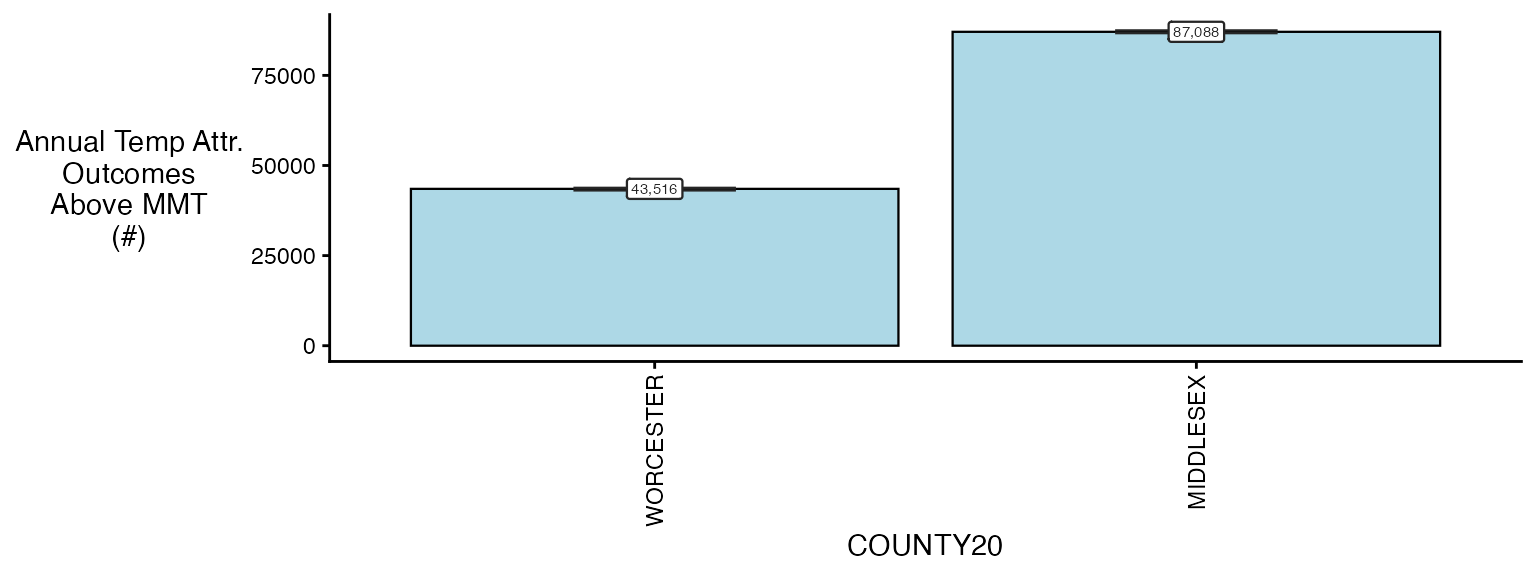
Estimating the AN - with factors
In the case where you have factors, you can easily extend this
outcome_columns <- list(
  "date" = "date",
  "outcome" = "daily_deaths",
  "factor" = "age_grp",
  "geo_unit" = "TOWN20",
  "geo_unit_grp" = "COUNTY20"
)

ma_outcomes_tbl_fct <- make_outcome_table(
  subset(ma_deaths,COUNTY20 %in% c('MIDDLESEX', 'WORCESTER')),
  outcome_columns,
  time_subset = list(month = 5:9, year = 2012:2015))
#> > Combined factor is  age_grp
#> Missing outcome values introduced by xgrid were set to 0;
#>             assumes that every time in the dataset should have an outcome value
#> strata dt_by = 'day', setting strata as geo_unit:yr:mn:dow

ma_model_fct <- condPois_2stage(ma_exposure_matrix,
                                ma_outcomes_tbl_fct,
                                global_cen = 15,
                                verbose = 1)
#> < age_grp : 0-17 >
#> -- validation passed
#> -- stage 1
#>
#> crossbasis args for geo_unit  ACTON :
#>
#> maxlag: 5
#>
#> argvar:
#> List of 2
#>  $ fun  : chr "ns"
#>  $ knots: Named num [1:2] 25.6 31.3
#>   ..- attr(*, "names")= chr [1:2] "50%" "90%"
#>
#> arglag:
#> List of 2
#>  $ fun  : chr "ns"
#>  $ knots: num [1:2] 0.878 2.095
#>
#> strata:
#> ACTON:yr2013:mn05:dow04
#> strata_min: 0
#>
#> min_n: 50
#>
#> truncate final RR and basis cen:  0
#> formula:
#>    daily_deaths ~ cb
#> family: quasipoisson
#>
#> -- mixmeta
#> formula: coef_matrix ~ exp_mean + exp_IQR
#> random: ~ 1 | COUNTY20/TOWN20
#> -- stage 2
#> truncate final RR and basis cen:  0.01
#>
#> < age_grp : 18-64 >
#> -- validation passed
#> -- stage 1
#>
#> crossbasis args for geo_unit  ACTON :
#>
#> maxlag: 5
#>
#> argvar:
#> List of 2
#>  $ fun  : chr "ns"
#>  $ knots: Named num [1:2] 25.6 31.3
#>   ..- attr(*, "names")= chr [1:2] "50%" "90%"
#>
#> arglag:
#> List of 2
#>  $ fun  : chr "ns"
#>  $ knots: num [1:2] 0.878 2.095
#>
#> strata:
#> ACTON:yr2013:mn05:dow04
#> strata_min: 0
#>
#> min_n: 50
#>
#> truncate final RR and basis cen:  0
#> formula:
#>    daily_deaths ~ cb
#> family: quasipoisson
#>
#> -- mixmeta
#> formula: coef_matrix ~ exp_mean + exp_IQR
#> random: ~ 1 | COUNTY20/TOWN20
#> -- stage 2
#> truncate final RR and basis cen:  0.01
#>
#> < age_grp : 65+ >
#> -- validation passed
#> -- stage 1
#>
#> crossbasis args for geo_unit  ACTON :
#>
#> maxlag: 5
#>
#> argvar:
#> List of 2
#>  $ fun  : chr "ns"
#>  $ knots: Named num [1:2] 25.6 31.3
#>   ..- attr(*, "names")= chr [1:2] "50%" "90%"
#>
#> arglag:
#> List of 2
#>  $ fun  : chr "ns"
#>  $ knots: num [1:2] 0.878 2.095
#>
#> strata:
#> ACTON:yr2013:mn05:dow04
#> strata_min: 0
#>
#> min_n: 50
#>
#> truncate final RR and basis cen:  0
#> formula:
#>    daily_deaths ~ cb
#> family: quasipoisson
#>
#> -- mixmeta
#> formula: coef_matrix ~ exp_mean + exp_IQR
#> random: ~ 1 | COUNTY20/TOWN20
#> -- stage 2
#> truncate final RR and basis cen:  0.01

ma_AN_fct <- calc_AN(ma_model_fct, ma_outcomes_tbl_fct,
                     ma_pop_data_long,
                 spatial_agg_type = 'COUNTY20',
                 spatial_join_col = 'TOWN20',
                 nsim = 100,
                 verbose = 1)
#> -- over-writing `scale` argument with factor scales
#> < age_grp : 0-17 >
#> Warning in calc_AN(model = sub_model, outcomes_tbl = sub_outcomes_tbl, pop_data
#> = sub_pop_data, : some pop data are zero
#> -- validation passed
#> -- estimate in each geo_unit
#> -- summarize by simulation
#> < age_grp : 18-64 >
#> -- validation passed
#> -- estimate in each geo_unit
#> -- summarize by simulation
#> < age_grp : 65+ >
#> -- validation passed
#> -- estimate in each geo_unit
#> -- summarize by simulation

plot(ma_AN_fct, "num", above_MMT = T)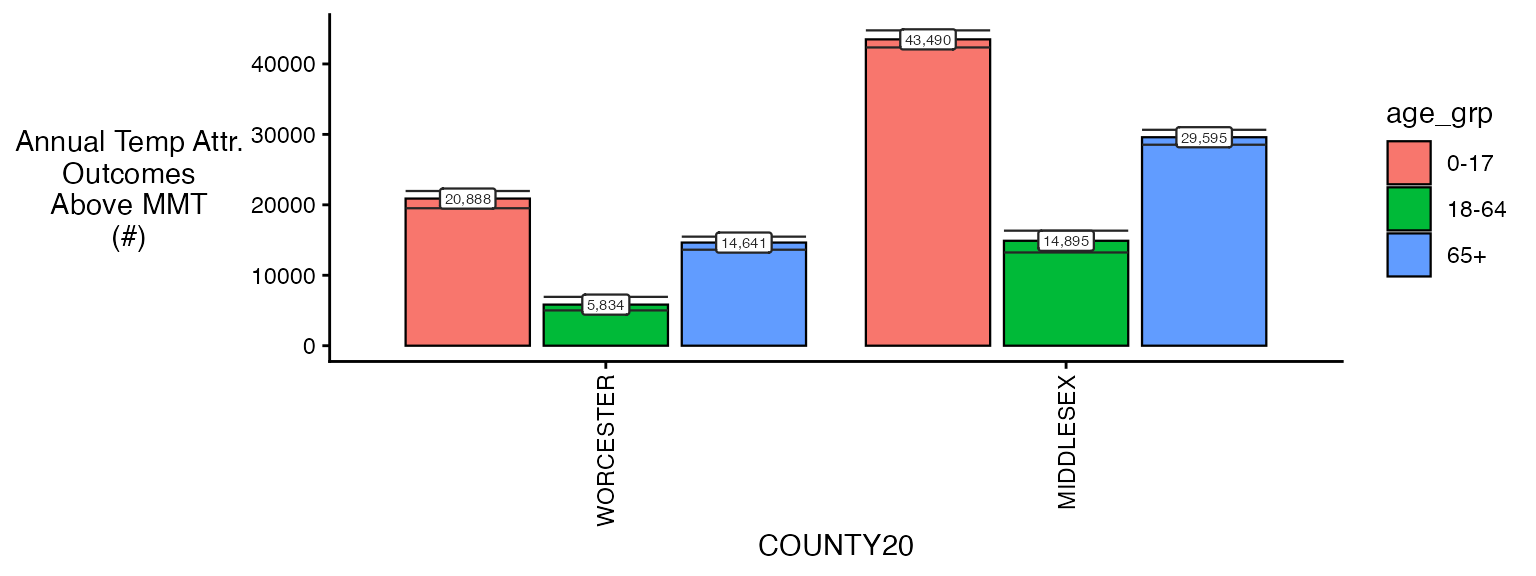
These results are fictional of course but show what kind of outputs can be made easily.
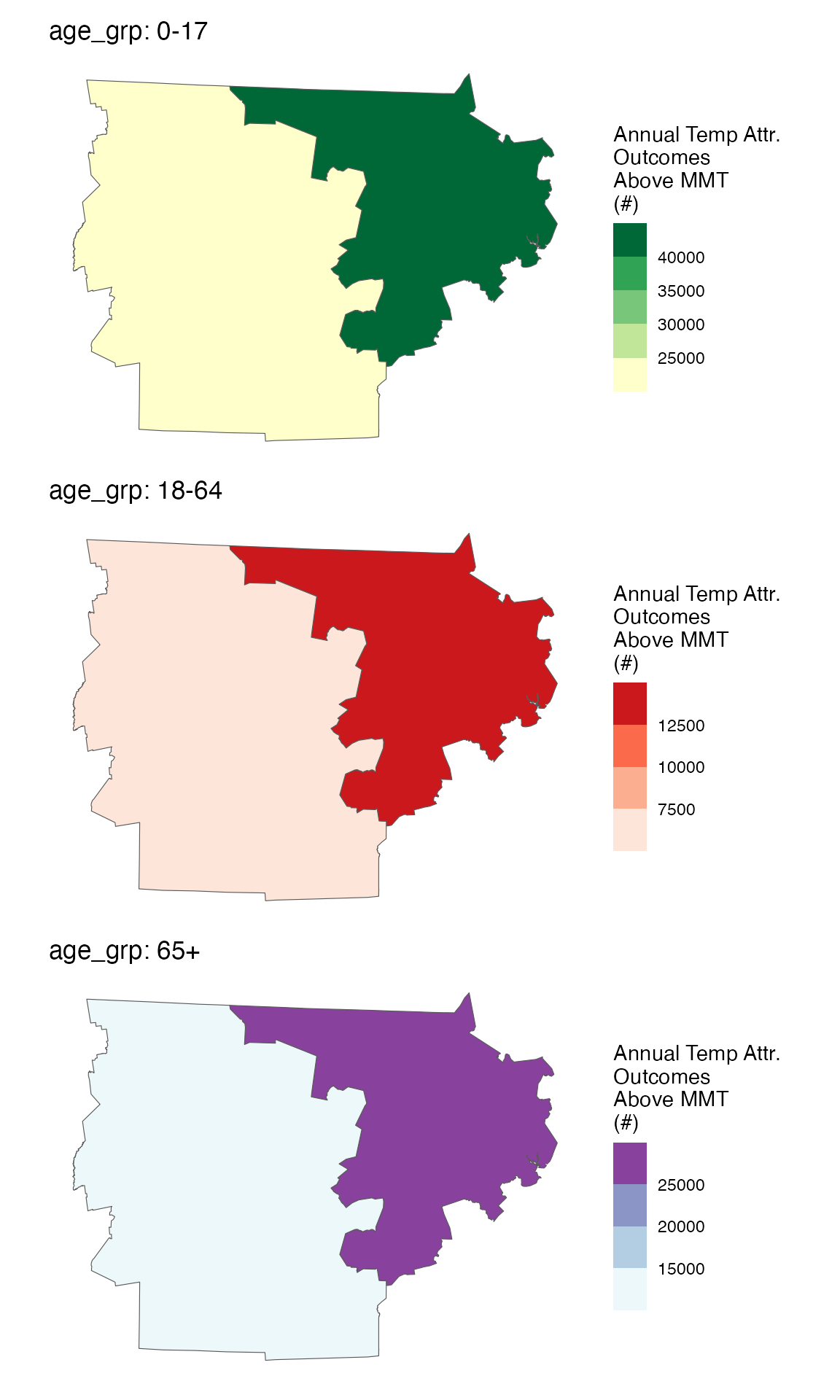
spatial_plot(ma_AN_fct, shp = ma_counties, table_type = "num", above_MMT = T)