Using Spatial Bayesian methods in `cityClimateHealth`
bayesian_demo.RmdAnother way that this model can be solved is by using Bayesian inference, implemented in STAN. We are including this implementation here so that it makes sense why we are including it later on.
The innovation here is combining the method of Armstrong 2014 with a spatial method, in this case BYM2.
We implemented the spatial bayesian method of BYM2 but instead of regular poisson as a conditional poisson (i.e., multinomial) which has performance gains that they articulate in Amrstrong.
This requires bringing in a shapefile, so you can define the network.
The standard application is using MCMC, we also include all STAN model types:
- MCMC
- laplace
- variational
- pathfinder
You can also experiment with speeding things up (at the risk of less precise estimates) using the laplace or variational method. see Jack’s notes as so what is going on here
Sb, basically a combination of these two things: https://academic.oup.com/ije/article/53/3/dyae061/7654027?guestAccessKey= https://link.springer.com/article/10.1186/1471-2288-14-122
A reminder that this data is simulated.
library(cityClimateHealth)
library(data.table)
data("ma_exposure")
data("ma_deaths")

# create exposure matrix
exposure_columns <- list(
  "date" = "date",
  "exposure" = "tmax_C",
  "geo_unit" = "TOWN20",
  "geo_unit_grp" = "COUNTY20"
)

TOWNLIST <- c('CHELSEA', 'EVERETT', 'REVERE', 'MALDEN')

exposure <- subset(ma_exposure, TOWN20 %in% TOWNLIST)

exposure_mat <- make_exposure_matrix(exposure,
                                     exposure_columns,
                                     time_subset = list(
                                       month = 5:9,
                                       year = 2012:2015
                                     ))
#> -- NA values automatically removed
#> strata dt_by = 'day', setting strata as geo_unit:yr:mn:dow

# create outcome table
outcome_columns <- list(
  "date" = "date",
  "outcome" = "daily_deaths",
  "geo_unit" = "TOWN20",
  "geo_unit_grp" = "COUNTY20"
)
deaths   <- subset(ma_deaths, TOWN20 %in% TOWNLIST)
deaths_tbl <- make_outcome_table(deaths,  outcome_columns,
                                 time_subset = list(
                                       month = 5:9,
                                       year = 2012:2015
                                     ))
#> Missing outcome values introduced by xgrid were set to 0;
#>             assumes that every time in the dataset should have an outcome value
#> strata dt_by = 'day', setting strata as geo_unit:yr:mn:dow

# plot
data("ma_towns")

library(ggplot2)
local_shp <- subset(ma_towns, TOWN20 %in%  TOWNLIST)
ggplot(local_shp) + geom_sf(aes(fill = TOWN20))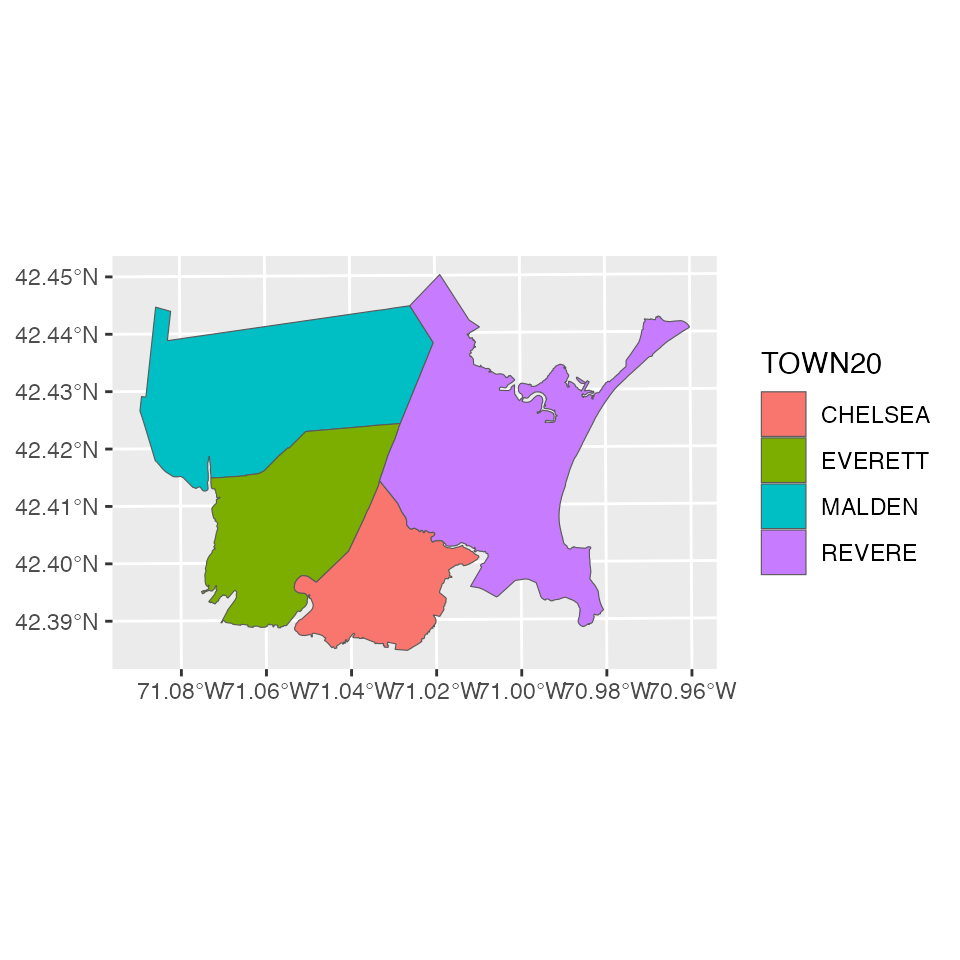
Now get initial estimates for each geo_unit
beta_l <- vector("list", 4)
cr_l <- vector("list", 4)
plot_l <- vector("list", 4)

cb_list <- vector("list", 4)
oo_list <- vector("list", 4)

for(bb in 1:4) {
  m1 <- condPois_1stage(
    subset(exposure_mat, TOWN20 == TOWNLIST[bb]),
    subset(deaths_tbl, TOWN20 == TOWNLIST[bb]),
    global_cen = 15)

  cb_list[[bb]] <- m1$`_`$out[[1]]$orig_basis
  oo_list[[bb]] <- m1$`_`$out[[1]]$outcomes

  beta_l[[bb]] <- m1$`_`$out[[1]]$orig_coef

  cr_l[[bb]] <- m1$`_`$out[[1]]$coef

  plot_l[[bb]] <- plot(m1)

}
#>
#> crossbasis args for geo_unit  CHELSEA :
#>
#> maxlag: 5
#>
#> argvar:
#> List of 2
#>  $ fun  : chr "ns"
#>  $ knots: Named num [1:2] 25.8 31.3
#>   ..- attr(*, "names")= chr [1:2] "50%" "90%"
#>
#> arglag:
#> List of 2
#>  $ fun  : chr "ns"
#>  $ knots: num [1:2] 0.878 2.095
#>
#> strata:
#> CHELSEA:yr2012:mn05:dow03
#> strata_min: 0
#>
#> min_n: 50
#>
#> truncate final RR and basis cen:  0.025
#> formula:
#>    daily_deaths ~ cb
#> family: quasipoisson
#>
#> crossbasis args for geo_unit  EVERETT :
#>
#> maxlag: 5
#>
#> argvar:
#> List of 2
#>  $ fun  : chr "ns"
#>  $ knots: Named num [1:2] 25.8 31
#>   ..- attr(*, "names")= chr [1:2] "50%" "90%"
#>
#> arglag:
#> List of 2
#>  $ fun  : chr "ns"
#>  $ knots: num [1:2] 0.878 2.095
#>
#> strata:
#> EVERETT:yr2012:mn05:dow03
#> strata_min: 0
#>
#> min_n: 50
#>
#> truncate final RR and basis cen:  0.025
#> formula:
#>    daily_deaths ~ cb
#> family: quasipoisson
#>
#> crossbasis args for geo_unit  REVERE :
#>
#> maxlag: 5
#>
#> argvar:
#> List of 2
#>  $ fun  : chr "ns"
#>  $ knots: Named num [1:2] 25.1 30.1
#>   ..- attr(*, "names")= chr [1:2] "50%" "90%"
#>
#> arglag:
#> List of 2
#>  $ fun  : chr "ns"
#>  $ knots: num [1:2] 0.878 2.095
#>
#> strata:
#> REVERE:yr2012:mn05:dow03
#> strata_min: 0
#>
#> min_n: 50
#>
#> truncate final RR and basis cen:  0.025
#> formula:
#>    daily_deaths ~ cb
#> family: quasipoisson
#>
#> crossbasis args for geo_unit  MALDEN :
#>
#> maxlag: 5
#>
#> argvar:
#> List of 2
#>  $ fun  : chr "ns"
#>  $ knots: Named num [1:2] 24.4 29
#>   ..- attr(*, "names")= chr [1:2] "50%" "90%"
#>
#> arglag:
#> List of 2
#>  $ fun  : chr "ns"
#>  $ knots: num [1:2] 0.878 2.095
#>
#> strata:
#> MALDEN:yr2012:mn05:dow03
#> strata_min: 0
#>
#> min_n: 50
#>
#> truncate final RR and basis cen:  0.025
#> formula:
#>    daily_deaths ~ cb
#> family: quasipoisson
mx <- do.call(cbind, beta_l) # COEFS NOT THE SAME
colnames(mx)  = TOWNLIST
mx
#>               CHELSEA     EVERETT        REVERE       MALDEN
#> cbv1.l1  0.0451309468  0.05298088 -0.0005224117  0.017711625
#> cbv1.l2 -0.0223211761 -0.03592669  0.0184129771  0.012490790
#> cbv1.l3  0.0873424413  0.08593669  0.1029649763  0.093454486
#> cbv1.l4 -0.0335859603 -0.03578575 -0.0337628164 -0.041517343
#> cbv2.l1  0.0852368471  0.05049362 -0.0533811289  0.039648824
#> cbv2.l2  0.0166508607 -0.11934992  0.0747314454  0.055829432
#> cbv2.l3  0.1926712791  0.18510476  0.1393985118  0.118837565
#> cbv2.l4 -0.0462482063 -0.04542133 -0.0608086198 -0.054356689
#> cbv3.l1  0.0170645385  0.07301390  0.0257165131  0.038563344
#> cbv3.l2 -0.0005616437 -0.06948122  0.0223225434 -0.002010598
#> cbv3.l3  0.1718665757  0.12512136  0.1186064940  0.130222731
#> cbv3.l4 -0.0490847643 -0.01913613 -0.0655887549 -0.044893272

mcr <- do.call(cbind, cr_l)   # COEFS THE SAME
colnames(mcr)  = TOWNLIST
mcr
#>      CHELSEA   EVERETT    REVERE    MALDEN
#> b1 0.1847675 0.1774954 0.2034421 0.1922760
#> b2 0.4637942 0.3065562 0.2523009 0.2921484
#> b3 0.3375227 0.2624969 0.2438566 0.2749740

library(patchwork)
wrap_plots(plot_l)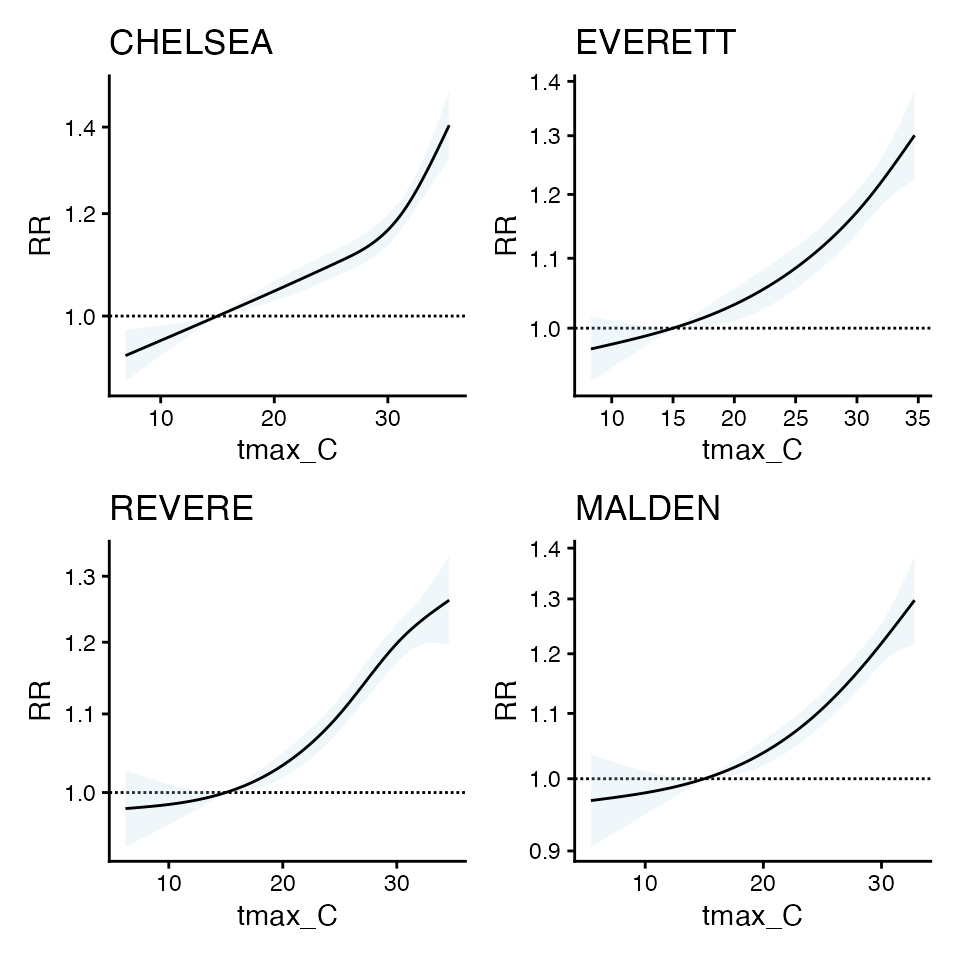
the cr coefs are similar
the orig_coefs are not, which is why beta-wise implementation of SB_DLNM method doesn’t work - because the don’t have to be the same to produce similar curves.
So, instead of forcing Beta to be similar, we can use bym2
refs:
- https://mc-stan.org/learn-stan/case-studies/icar_stan.html
- https://link.springer.com/article/10.1186/1476-072X-4-31
- https://github.com/stan-dev/example-models/blob/e5b7d9e2e9ecc375805c7e49e4a4d4c1882b5e3b/knitr/car-iar-poisson/bym2_predictor_plus_offset.stan#L4
ok here’s the ref of how LAPLACE works:
- https://mc-stan.org/cmdstanr/reference/model-method-laplace.html
- https://statmodeling.stat.columbia.edu/2023/02/08/implementing-laplace-approximation-in-stan-whats-happening-under-the-hood/
I think this makes for a good candidate because betas are normal and the model is not hierarchical
m_sb1 <- condPois_sb(exposure_mat, deaths_tbl, local_shp,
                     stan_type = 'mcmc',
                     verbose = 2,
                     global_cen = 15,
                     stan_opts = list(refresh = 200),
                     use_spatial_model = 'none')
#>  STAN TYPE = mcmc
#>  SPATIAL MODEL = none
#> -- validation passed
#> truncate final RR and basis cen:  0.01
#> -- prepare inputs
#> CHELSEA
#> crossbasis args for geo_unit  CHELSEA :
#>
#> maxlag: 5
#>
#> argvar:
#> List of 2
#>  $ fun  : chr "ns"
#>  $ knots: Named num [1:2] 25.8 31.3
#>   ..- attr(*, "names")= chr [1:2] "50%" "90%"
#>
#> arglag:
#> List of 2
#>  $ fun  : chr "ns"
#>  $ knots: num [1:2] 0.878 2.095
#>
#> strata:
#> CHELSEA:yr2012:mn05:dow03
#> strata_min: 0
#>
#> min_n: 1
#>
#> truncate final RR and basis cen:  0
#> formula:
#>    daily_deaths ~ cb
#> family: quasipoisson
#> EVERETT  MALDEN  REVERE
#> Warning in getSW(shp = shp_sf_safe, ni = 1, include_self = F): has to be one
#> polygon per row in `shp`
#>
#> -- run STAN
#> ld: warning: object file (/Users/cwm/.cmdstan/cmdstan-2.38.0/src/cmdstan/main.o) was built for newer 'macOS' version (26.0) than being linked (15.5)
#>  ...mcmc...
#> Running MCMC with 2 parallel chains...
#>
#> Chain 1 Iteration:    1 / 2000 [  0%]  (Warmup)
#> Chain 2 Iteration:    1 / 2000 [  0%]  (Warmup)
#> Chain 1 Iteration:  200 / 2000 [ 10%]  (Warmup)
#> Chain 2 Iteration:  200 / 2000 [ 10%]  (Warmup)
#> Chain 1 Iteration:  400 / 2000 [ 20%]  (Warmup)
#> Chain 2 Iteration:  400 / 2000 [ 20%]  (Warmup)
#> Chain 1 Iteration:  600 / 2000 [ 30%]  (Warmup)
#> Chain 2 Iteration:  600 / 2000 [ 30%]  (Warmup)
#> Chain 1 Iteration:  800 / 2000 [ 40%]  (Warmup)
#> Chain 2 Iteration:  800 / 2000 [ 40%]  (Warmup)
#> Chain 1 Iteration: 1000 / 2000 [ 50%]  (Warmup)
#> Chain 1 Iteration: 1001 / 2000 [ 50%]  (Sampling)
#> Chain 2 Iteration: 1000 / 2000 [ 50%]  (Warmup)
#> Chain 2 Iteration: 1001 / 2000 [ 50%]  (Sampling)
#> Chain 1 Iteration: 1200 / 2000 [ 60%]  (Sampling)
#> Chain 2 Iteration: 1200 / 2000 [ 60%]  (Sampling)
#> Chain 1 Iteration: 1400 / 2000 [ 70%]  (Sampling)
#> Chain 2 Iteration: 1400 / 2000 [ 70%]  (Sampling)
#> Chain 1 Iteration: 1600 / 2000 [ 80%]  (Sampling)
#> Chain 2 Iteration: 1600 / 2000 [ 80%]  (Sampling)
#> Chain 1 Iteration: 1800 / 2000 [ 90%]  (Sampling)
#> Chain 2 Iteration: 1800 / 2000 [ 90%]  (Sampling)
#> Chain 1 Iteration: 2000 / 2000 [100%]  (Sampling)
#> Chain 1 finished in 27.8 seconds.
#> Chain 2 Iteration: 2000 / 2000 [100%]  (Sampling)
#> Chain 2 finished in 28.5 seconds.
#>
#> Both chains finished successfully.
#> Mean chain execution time: 28.2 seconds.
#> Total execution time: 28.7 seconds.
#>
#>  ...mcmc draws...
#> CHELSEA  EVERETT     MALDEN  REVERE
#> -- apply estimates
#> truncate final RR and basis cen:  0.01
Compare, first you can see that with spatial_model = F, there is similarity in beta coefs
mx
#>               CHELSEA     EVERETT        REVERE       MALDEN
#> cbv1.l1  0.0451309468  0.05298088 -0.0005224117  0.017711625
#> cbv1.l2 -0.0223211761 -0.03592669  0.0184129771  0.012490790
#> cbv1.l3  0.0873424413  0.08593669  0.1029649763  0.093454486
#> cbv1.l4 -0.0335859603 -0.03578575 -0.0337628164 -0.041517343
#> cbv2.l1  0.0852368471  0.05049362 -0.0533811289  0.039648824
#> cbv2.l2  0.0166508607 -0.11934992  0.0747314454  0.055829432
#> cbv2.l3  0.1926712791  0.18510476  0.1393985118  0.118837565
#> cbv2.l4 -0.0462482063 -0.04542133 -0.0608086198 -0.054356689
#> cbv3.l1  0.0170645385  0.07301390  0.0257165131  0.038563344
#> cbv3.l2 -0.0005616437 -0.06948122  0.0223225434 -0.002010598
#> cbv3.l3  0.1718665757  0.12512136  0.1186064940  0.130222731
#> cbv3.l4 -0.0490847643 -0.01913613 -0.0655887549 -0.044893272

m_sb1$`_`$beta_mat
#>             CHELSEA     EVERETT       MALDEN        REVERE
#>  [1,]  0.0449298239  0.05098583  0.017756650 -5.620109e-05
#>  [2,] -0.0214329543 -0.03426758  0.011841185  1.782888e-02
#>  [3,]  0.0870379276  0.08616681  0.094052657  1.031983e-01
#>  [4,] -0.0338684705 -0.03555364 -0.041411317 -3.358647e-02
#>  [5,]  0.0897929443  0.04970541  0.037003716 -5.185453e-02
#>  [6,]  0.0182988655 -0.11715244  0.055657008  7.507643e-02
#>  [7,]  0.1908459686  0.18290960  0.119302767  1.383370e-01
#>  [8,] -0.0466619763 -0.04527623 -0.053068854 -5.968812e-02
#>  [9,]  0.0171930332  0.07305390  0.037493866  2.501320e-02
#> [10,]  0.0004724395 -0.06957477 -0.001753442  2.245419e-02
#> [11,]  0.1719982821  0.12431039  0.129585861  1.186075e-01
#> [12,] -0.0494709525 -0.01945691 -0.044258216 -6.541213e-02
Compare with spatial model
using laplace in this case, but you could try mcmc
m_sb2 <- condPois_sb(exposure_mat, deaths_tbl, local_shp,
                     stan_type = 'laplace',
                     verbose = 2,
                     global_cen = 15,
                     stan_opts = list(refresh = 200),
                     use_spatial_model = 'bym2')
#>  STAN TYPE = laplace
#>  SPATIAL MODEL = bym2
#> -- validation passed
#> truncate final RR and basis cen:  0.01
#> -- prepare inputs
#> CHELSEA
#> crossbasis args for geo_unit  CHELSEA :
#>
#> maxlag: 5
#>
#> argvar:
#> List of 2
#>  $ fun  : chr "ns"
#>  $ knots: Named num [1:2] 25.8 31.3
#>   ..- attr(*, "names")= chr [1:2] "50%" "90%"
#>
#> arglag:
#> List of 2
#>  $ fun  : chr "ns"
#>  $ knots: num [1:2] 0.878 2.095
#>
#> strata:
#> CHELSEA:yr2012:mn05:dow03
#> strata_min: 0
#>
#> min_n: 1
#>
#> truncate final RR and basis cen:  0
#> formula:
#>    daily_deaths ~ cb
#> family: quasipoisson
#> EVERETT  MALDEN  REVERE
#> Warning in getSW(shp = shp_sf_safe, ni = 1, include_self = F): has to be one
#> polygon per row in `shp`
#>
#> -- run STAN
#> ld: warning: object file (/Users/cwm/.cmdstan/cmdstan-2.38.0/src/cmdstan/main.o) was built for newer 'macOS' version (26.0) than being linked (15.5)
#>  ...laplace optimize...
#> Initial log joint probability = -6739.06
#>     Iter      log prob        ||dx||      ||grad||       alpha      alpha0  # evals  Notes
#>      142      -6737.27   9.71025e-05        1.0085           1           1      166
#> Optimization terminated normally:
#>   Convergence detected: relative gradient magnitude is below tolerance
#> Finished in  0.2 seconds.
#>  ...laplace sample...
#> Calculating Hessian
#> Calculating inverse of Cholesky factor
#> Generating draws
#> iteration: 0
#> iteration: 100
#> iteration: 200
#> iteration: 300
#> iteration: 400
#> iteration: 500
#> iteration: 600
#> iteration: 700
#> iteration: 800
#> iteration: 900
#> Finished in  0.6 seconds.
#>  ...laplace draws...
#> CHELSEA  EVERETT     MALDEN  REVERE
#> -- apply estimates
#> truncate final RR and basis cen:  0.01
Compare, now you can see these are different
mx
#>               CHELSEA     EVERETT        REVERE       MALDEN
#> cbv1.l1  0.0451309468  0.05298088 -0.0005224117  0.017711625
#> cbv1.l2 -0.0223211761 -0.03592669  0.0184129771  0.012490790
#> cbv1.l3  0.0873424413  0.08593669  0.1029649763  0.093454486
#> cbv1.l4 -0.0335859603 -0.03578575 -0.0337628164 -0.041517343
#> cbv2.l1  0.0852368471  0.05049362 -0.0533811289  0.039648824
#> cbv2.l2  0.0166508607 -0.11934992  0.0747314454  0.055829432
#> cbv2.l3  0.1926712791  0.18510476  0.1393985118  0.118837565
#> cbv2.l4 -0.0462482063 -0.04542133 -0.0608086198 -0.054356689
#> cbv3.l1  0.0170645385  0.07301390  0.0257165131  0.038563344
#> cbv3.l2 -0.0005616437 -0.06948122  0.0223225434 -0.002010598
#> cbv3.l3  0.1718665757  0.12512136  0.1186064940  0.130222731
#> cbv3.l4 -0.0490847643 -0.01913613 -0.0655887549 -0.044893272

m_sb2$`_`$beta_mat
#>           CHELSEA     EVERETT        MALDEN        REVERE
#>  [1,]  0.04560060  0.05114328  0.0192614650  0.0004440692
#>  [2,] -0.02136005 -0.03352721  0.0114673169  0.0170481307
#>  [3,]  0.08604747  0.08582106  0.0919990434  0.1026785924
#>  [4,] -0.03305026 -0.03706412 -0.0404529665 -0.0335976226
#>  [5,]  0.08883740  0.04874329  0.0361070381 -0.0515015870
#>  [6,]  0.02009684 -0.11138718  0.0620480180  0.0753556517
#>  [7,]  0.18716755  0.18245957  0.1163180214  0.1373785018
#>  [8,] -0.04244336 -0.04714689 -0.0540917979 -0.0611999517
#>  [9,]  0.01606870  0.07257075  0.0373433303  0.0263827045
#> [10,]  0.00154234 -0.06652991 -0.0000122011  0.0224258975
#> [11,]  0.17237064  0.12428316  0.1292201394  0.1186875579
#> [12,] -0.04890898 -0.01975545 -0.0451037722 -0.0657143776
Compare with spatial model for leroux
using laplace in this case, but you could try mcmc
m_sb3 <- condPois_sb(exposure_mat,
                     deaths_tbl, local_shp,
                     stan_type = 'laplace',
                     verbose = 2,
                     stan_opts = list(refresh = 200),
                     use_spatial_model = 'leroux')
#>  STAN TYPE = laplace
#>  SPATIAL MODEL = leroux
#> -- validation passed
#> truncate final RR and basis cen:  0.01
#> -- prepare inputs
#> CHELSEA
#> crossbasis args for geo_unit  CHELSEA :
#>
#> maxlag: 5
#>
#> argvar:
#> List of 2
#>  $ fun  : chr "ns"
#>  $ knots: Named num [1:2] 25.8 31.3
#>   ..- attr(*, "names")= chr [1:2] "50%" "90%"
#>
#> arglag:
#> List of 2
#>  $ fun  : chr "ns"
#>  $ knots: num [1:2] 0.878 2.095
#>
#> strata:
#> CHELSEA:yr2012:mn05:dow03
#> strata_min: 0
#>
#> min_n: 1
#>
#> truncate final RR and basis cen:  0
#> formula:
#>    daily_deaths ~ cb
#> family: quasipoisson
#> Warning in condPois_1stage(exposure_matrix = single_exposure_matrix, outcomes_tbl = single_outcomes_tbl, : Centering point is outside the range of exposures in geo-unit CHELSEA: Cen = 6.90, x_b = (7.00, 36.00).
#>         This means your zones are across too large of an area, or if exposure is factor there could
#>         be too few events in this area, or
#>         there are differences in exposures so much that the bases are quite different. Try limiting the geo-units passed in to those that are more similar, manually setting a centering point that you know each geo-unit has, or changing your exposure variable.
#> EVERETT  MALDEN  REVERE
#> Warning in condPois_1stage(exposure_matrix = single_exposure_matrix, outcomes_tbl = single_outcomes_tbl, : Centering point is outside the range of exposures in geo-unit REVERE: Cen = 6.20, x_b = (7.00, 35.00).
#>         This means your zones are across too large of an area, or if exposure is factor there could
#>         be too few events in this area, or
#>         there are differences in exposures so much that the bases are quite different. Try limiting the geo-units passed in to those that are more similar, manually setting a centering point that you know each geo-unit has, or changing your exposure variable.
#> Warning in getSW(shp = shp_sf_safe, ni = 1, include_self = F): has to be one
#> polygon per row in `shp`
#>
#> -- run STAN
#> ld: warning: object file (/Users/cwm/.cmdstan/cmdstan-2.38.0/src/cmdstan/main.o) was built for newer 'macOS' version (26.0) than being linked (15.5)
#>  ...laplace optimize...
#> Initial log joint probability = -7000.25
#>     Iter      log prob        ||dx||      ||grad||       alpha      alpha0  # evals  Notes
#>      199      -6469.49      0.011165       3656.03      0.1727      0.1727      221
#>     Iter      log prob        ||dx||      ||grad||       alpha      alpha0  # evals  Notes
#>      399      -6429.55   0.000217749       1936.21      0.4995           1      434
#>     Iter      log prob        ||dx||      ||grad||       alpha      alpha0  # evals  Notes
#>      599      -6428.11   0.000275851       2066.37           1           1      640
#>     Iter      log prob        ||dx||      ||grad||       alpha      alpha0  # evals  Notes
#>      799      -6426.87   6.85942e-05       359.465           1           1      846
#>     Iter      log prob        ||dx||      ||grad||       alpha      alpha0  # evals  Notes
#>      999      -6426.48   3.10879e-05       565.572      0.3176           1     1059
#>     Iter      log prob        ||dx||      ||grad||       alpha      alpha0  # evals  Notes
#>     1199      -6426.25   1.68203e-05       300.567           1           1     1267
#>     Iter      log prob        ||dx||      ||grad||       alpha      alpha0  # evals  Notes
#>     1399      -6426.09   6.97945e-05       548.354           1           1     1474
#>     Iter      log prob        ||dx||      ||grad||       alpha      alpha0  # evals  Notes
#>     1599      -6425.76   3.08219e-05       215.838           1           1     1686
#>     Iter      log prob        ||dx||      ||grad||       alpha      alpha0  # evals  Notes
#>     1799      -6425.66    1.4608e-05       387.062      0.4803           1     1901
#>     Iter      log prob        ||dx||      ||grad||       alpha      alpha0  # evals  Notes
#>     1999       -6425.6   4.25635e-05       151.952           1           1     2114
#>     Iter      log prob        ||dx||      ||grad||       alpha      alpha0  # evals  Notes
#>     2199      -6425.54   7.76889e-05       286.337           1           1     2326
#>     Iter      log prob        ||dx||      ||grad||       alpha      alpha0  # evals  Notes
#>     2399      -6424.79    0.00112198       799.851           1           1     2535
#>     Iter      log prob        ||dx||      ||grad||       alpha      alpha0  # evals  Notes
#>     2599      -6424.39   0.000332899       442.868           1           1     2743
#>     Iter      log prob        ||dx||      ||grad||       alpha      alpha0  # evals  Notes
#>     2799      -6424.24     9.566e-05       212.971           1           1     2950
#>     Iter      log prob        ||dx||      ||grad||       alpha      alpha0  # evals  Notes
#>     2999      -6424.07   7.34774e-06       288.903      0.7361      0.7361     3163
#>     Iter      log prob        ||dx||      ||grad||       alpha      alpha0  # evals  Notes
#>     3199      -6423.96   1.20432e-05       170.227           1           1     3371
#>     Iter      log prob        ||dx||      ||grad||       alpha      alpha0  # evals  Notes
#>     3310      -6423.86   7.02828e-07       42.1594           1           1     3488
#> Optimization terminated normally:
#>   Convergence detected: relative gradient magnitude is below tolerance
#> Finished in  1.5 seconds.
#>  ...laplace sample...
#> Calculating Hessian
#> Calculating inverse of Cholesky factor
#> Generating draws
#> iteration: 0
#> iteration: 100
#> iteration: 200
#> iteration: 300
#> iteration: 400
#> iteration: 500
#> iteration: 600
#> iteration: 700
#> iteration: 800
#> iteration: 900
#> Finished in  0.6 seconds.
#>  ...laplace draws...
#> CHELSEA  EVERETT     MALDEN  REVERE
#> -- apply estimates
#> truncate final RR and basis cen:  0.01
As you can see, lots of smoothing to a central estimate !
mx
#>               CHELSEA     EVERETT        REVERE       MALDEN
#> cbv1.l1  0.0451309468  0.05298088 -0.0005224117  0.017711625
#> cbv1.l2 -0.0223211761 -0.03592669  0.0184129771  0.012490790
#> cbv1.l3  0.0873424413  0.08593669  0.1029649763  0.093454486
#> cbv1.l4 -0.0335859603 -0.03578575 -0.0337628164 -0.041517343
#> cbv2.l1  0.0852368471  0.05049362 -0.0533811289  0.039648824
#> cbv2.l2  0.0166508607 -0.11934992  0.0747314454  0.055829432
#> cbv2.l3  0.1926712791  0.18510476  0.1393985118  0.118837565
#> cbv2.l4 -0.0462482063 -0.04542133 -0.0608086198 -0.054356689
#> cbv3.l1  0.0170645385  0.07301390  0.0257165131  0.038563344
#> cbv3.l2 -0.0005616437 -0.06948122  0.0223225434 -0.002010598
#> cbv3.l3  0.1718665757  0.12512136  0.1186064940  0.130222731
#> cbv3.l4 -0.0490847643 -0.01913613 -0.0655887549 -0.044893272

m_sb3$`_`$beta_mat
#>           CHELSEA     EVERETT      MALDEN      REVERE
#>  [1,]  0.03715796  0.03715809  0.03715812  0.03715815
#>  [2,] -0.01298288 -0.01298270 -0.01298258 -0.01298252
#>  [3,]  0.09122640  0.09122647  0.09122681  0.09122685
#>  [4,] -0.03428302 -0.03428300 -0.03428290 -0.03428279
#>  [5,]  0.07403632  0.07403232  0.07403180  0.07403105
#>  [6,] -0.03436285 -0.03436365 -0.03436415 -0.03436368
#>  [7,]  0.14257325  0.14257324  0.14257310  0.14257299
#>  [8,] -0.03692764 -0.03692765 -0.03692761 -0.03692762
#>  [9,]  0.05283356  0.05283356  0.05283373  0.05283381
#> [10,] -0.02389770 -0.02389777 -0.02389762 -0.02389754
#> [11,]  0.13000907  0.13000880  0.13000897  0.13000891
#> [12,] -0.03937868 -0.03937865 -0.03937873 -0.03937892
And you can also see that the leroux q value is quite
high
subset(m_sb3$`_`$stan_summary, variable == 'q')
#> # A tibble: 1 × 7
#>   variable  mean median    sd      mad       q5   q95
#>   <chr>    <dbl>  <dbl> <dbl>    <dbl>    <dbl> <dbl>
#> 1 q        0.691  0.999 0.440 0.000203 6.75e-11 0.999
All of the other objects associated with condPois_1stage
or condPois_2stage will also work here, along with the
_list and factor coding